
What Makes a Great Attraction for Family Entertainment Centers
The Six-Month Problem
Every FEC operator has lived this story. You add a new attraction. The first few weekends are packed. Social media lights up. The staff is excited. Then, slowly, the crowds thin. Within six months, the new thing has become just another thing on the floor — blending into the background alongside the go-karts, the trampolines, and the arcade cabinets.
The problem isn't that the attraction was bad. It's that the entertainment industry has a novelty half-life, and most attractions are static. They deliver the same experience on day one as they do on day 300. Guests try it, enjoy it, and move on to the next new thing — which is usually at a competitor's venue.
The real question for FEC operators isn't "what's new?" It's "what stays new?"
Running a family entertainment center means balancing two forces that constantly pull against each other. You need variety — guests expect multiple activities under one roof. But you also need anchors — one or two attractions that are the reason people come in the first place. An anchor isn't just popular on opening weekend. It's the thing guests mention when they tell friends where to go. It's the thing that fills your booking calendar three weeks out. And increasingly, it's the thing that works not just for the people playing, but for everyone else in the building.
The Group Problem No One Talks About
Here's a pattern that plays out at FECs every single day, and most operators have become so used to it that they don't even register it as a problem anymore.
A group of eight arrives for a birthday party. They're excited. They've been looking forward to this. But only four can play the main attraction at a time. The other four sit on a bench nearby. They scroll their phones. They wander to the arcade. The group — the thing that drove the booking in the first place — fragments within the first twenty minutes.
The parents who booked the party notice. The kids who are waiting notice. And when it's time to decide where to host the next birthday party, they remember that feeling of waiting more than they remember the attraction itself.
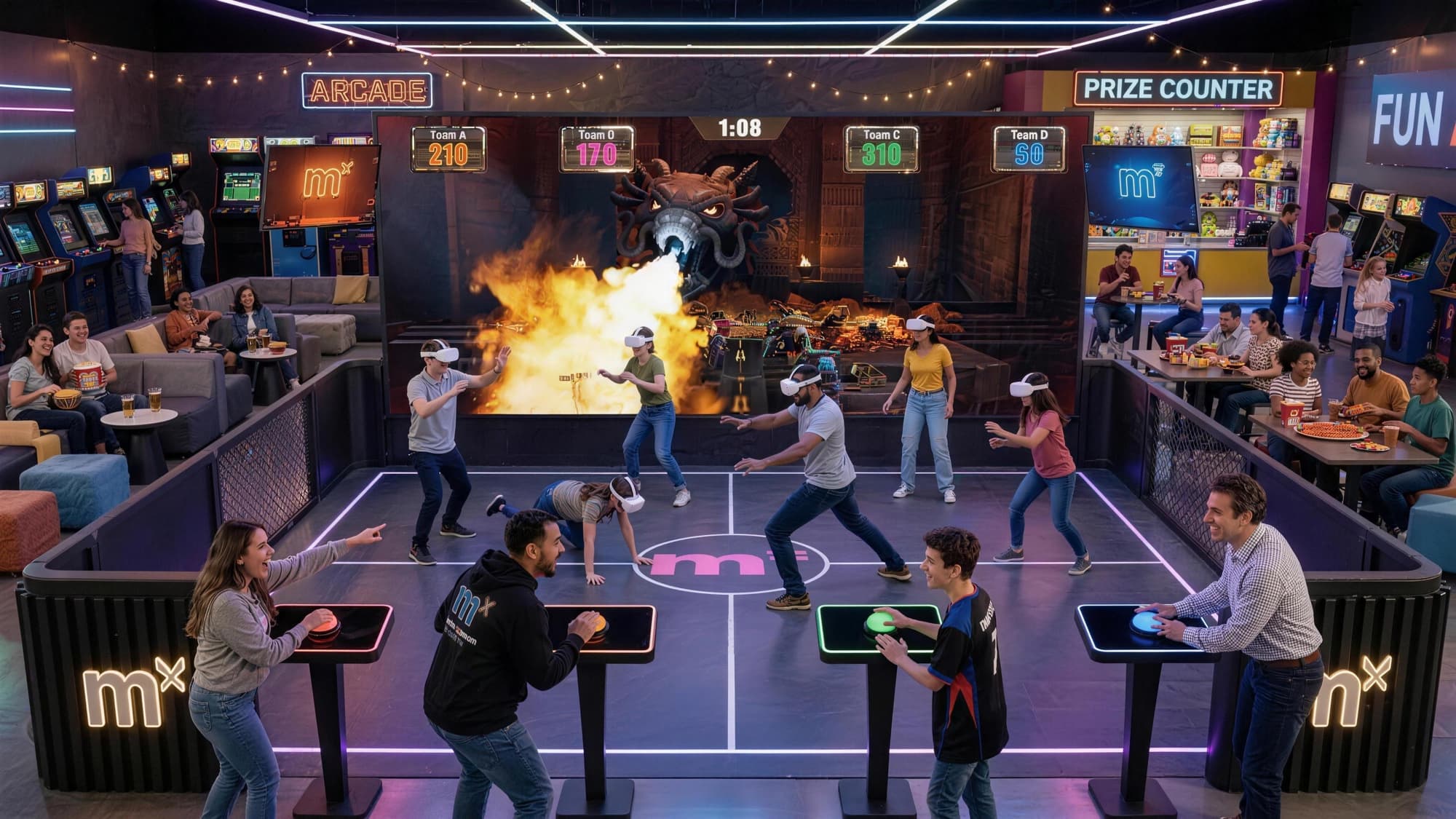
Now imagine the opposite. The four who aren't playing are gathered around a massive LED screen, watching their friends' gameplay unfold in real time — cinematic camera angles, live scores, instant replays. They're cheering. They're filming. They're ordering food because they're settled in and entertained. The birthday kid's name is on the screen between rounds. The whole group is sharing the same experience even though only half of them are wearing headsets.
That's the difference between an attraction that serves individuals and one that serves groups. And for FECs — where birthday parties, corporate outings, and friend groups drive the majority of revenue — that difference is everything.
What Separates a Great Anchor From Another Piece of Equipment
After looking at what works and what doesn't across dozens of FEC formats, a pattern emerges. The attractions that become real anchors — the ones that drive bookings, generate repeat visits, and justify their square footage year after year — share five specific traits.
They're built for groups from the ground up. Not adapted for groups as an afterthought. The core experience is designed so that whether you brought 6 people or 30, everyone has a role — playing, watching, competing, cheering. The group stays together. The energy builds instead of dissipating.
They have a real spectator layer. This is the single biggest differentiator between attractions that drive dwell time and ones that don't. When non-players are genuinely entertained — watching a live show, not staring at someone in a headset — they stay longer, spend more on food and drinks, and create social media content organically. An engaged spectator area isn't dead space. It's a profit center.
They refresh through software, not hardware. The attractions that drive repeat visits are the ones that feel different every time. New games every quarter. Seasonal themes. Limited-time competitive events. And crucially, these updates arrive as software — not as vendor visits, construction projects, or weeks of downtime. If refreshing the experience requires shutting down the attraction, it's not sustainable.
They're operationally simple. FEC operators don't have the luxury of dedicated technical teams for every attraction. The best ones are operable by a single staff member, fast to reset between groups, low maintenance without daily calibration, and self-explanatory enough that guests understand the format in thirty seconds without a lengthy briefing.
They generate disproportionate revenue per square foot. Floor space is the most expensive resource in a FEC, and every square foot needs to earn its keep. The best anchors aren't just popular — they drive throughput, extend dwell time, generate secondary spending on food and beverage, and create bookable experiences like corporate events, birthday packages, and league nights that fill the calendar weeks in advance.
Where Today's FEC Staples Fall Short
This isn't about bashing the attractions that built the industry. It's about understanding their structural limitations so you can see where the next generation needs to go.
Arcades and redemption games generate reliable per-play revenue, but they're commoditized. Every FEC has them. They don't create differentiation and they rarely create the "I have to try that" moment that drives a first visit or a social media post.
Escape rooms have a great group format, but they're capacity-constrained in a way that's hard to fix. One group per room per hour. Scaling throughput means building more rooms — which means more square footage, more theming costs, and more staff. The math gets difficult quickly.
Laser tag is fun and familiar, but the format is essentially unchanged from twenty years ago. It doesn't generate shareable social media content, and there's no spectator experience — friends who aren't playing have nothing to do but wait.
Traditional VR delivers an incredible experience for the person in the headset, but it isolates them from everyone else. Spectators watch someone flail in a dark room and see nothing of the game itself. The group experience breaks down, and the "wow" moment is invisible to anyone not wearing a headset.
Go-karts and trampolines drive solid throughput and are popular with younger demographics, but they're physically intensive, age-restrictive, and maintenance-heavy. They also don't naturally create dwell time for the rest of the group — non-participants wait, rather than engage.
The Format That Checks Every Box
A new category is emerging in the FEC space that addresses each of these limitations. It's called the Social Game Arena, and the concept is straightforward.
A physical arena — roughly 25 by 25 feet — where up to eight players compete in hands-free VR party games. No controllers, no tutorials, just full-body movement. While players are in the game, a massive LED wall broadcasts everything in real time: cinematic camera angles, live scores, instant replays, and highlight moments. An integrated show production system runs the entire experience automatically — team intros, leaderboards, highlight reels, virtual host — without requiring a human MC, DJ, or technical crew.
Content refreshes quarterly as software updates. The experience your guests had last visit is different from what they'll get next time. And one staff member runs the whole thing.
Here's why this format is transforming FECs specifically.
Birthday parties become the hero product. The birthday kid's name goes up on the 25-foot screen. Teams compete in team colors. Parents film from the spectator lounge while their drinks arrive. It's the birthday party that kids talk about at school — and that parents recommend to every other parent in the group chat.
Corporate events fill weeknights. Team building that people genuinely enjoy — not trust falls, not awkward icebreakers. Teams compete, spectators cheer from the bar area, and groups of 20 to 50 cycle through in a format that's structured enough to feel organized but loose enough to feel like a night out.
Throughput is built into the design. Eight players per session, with sessions as short as 10 minutes for quick-play formats or up to 75 minutes for full tournament productions. The arena cycles groups efficiently without feeling rushed.
The spectator area generates its own revenue. Non-players aren't parked on a bench. They're watching a live show, ordering food and drinks, and creating social media content. That spectator zone — the space most attractions treat as dead square footage — becomes one of the highest-revenue areas in the building.
And the experience stays fresh without touching the hardware. New games, seasonal themes, branded activations, competitive leagues — all delivered as software. The venue that opened in January doesn't feel like the same venue in June. That's what drives the repeat visit that every FEC operator is chasing.
The Licensing Model
The best Social Game Arena platforms operate on a licensing model rather than an outright equipment sale. The platform provider delivers hardware, software, the full game catalog, staff training, installation support, and ongoing updates. The FEC provides the space and one operator. Pricing is performance-based, so costs scale with your success.
This matters because it changes the risk profile entirely. There's no massive upfront purchase that depreciates. Content development isn't the operator's burden. Software evolution — new games, new features, seasonal content — is included in the model. And because both sides earn more when the arena is busy, incentives are aligned from day one.
How to Evaluate Any New Anchor Attraction
Whether you're looking at a Social Game Arena or any other format, here's the framework that separates real anchors from expensive novelties.
Ask whether it serves groups of 6 to 30, or whether it's really designed for individuals. Ask what non-players do — do they watch a show, or do they check their phones? Ask how often the experience changes, and whether that change comes through software or through hardware swaps and construction. Ask how many staff it takes to operate and whether one person can run a full session. Ask about revenue per square foot including food, beverage, and bookings — not just ticket sales. And ask whether guests will film it and share it, or whether there's nothing visible from outside the experience.
The attractions that score well across all six questions are the ones that become real anchors — the reason people choose your venue over the one down the road.
The Bottom Line
The FEC market is evolving faster than it has in decades. Guests have more choices than ever, and their expectations are shaped by experiences far beyond your local competitors — by theme parks, immersive events, and viral social media content.
The attractions that will define the next generation of family entertainment centers aren't the ones with the most impressive hardware specs. They're the ones that keep groups together, create moments worth sharing, and feel different every time someone comes back.
That's not a technology problem. It's a design philosophy. And the operators who get it right will be the ones guests keep choosing.
See how the Social Game Arena platform works → Bring Mirra Arena to Your Venue